
Conversation with A Mom of a Down Syndrome Baby
When hope climbed into her lap…
Averie was three years old when she climbed into a stranger’s lap.
At a family member’s high school soccer game, Marty, her mother, was practicing the hard discipline of letting Averie do small things on her own – a particular kind of patience required of any parent of a child with disabilities. When Averie wanted to climb a few rows up the bleachers, Marty let her go.
Averie made her way up to a woman sitting alone. The woman was very pregnant.
Without asking permission, Averie climbed into her lap, put her hand on the woman’s stomach, and started to gently rub her tummy. That embrace was permission to let go. The anxiety, fear, and grief she’d held back came flooding out and the woman began crying.
Marty caught up with her daughter and apologized, thinking Averie might have hurt the woman in some way. The woman said no, the baby hadn’t hurt her, she was fine. “I just found out today that my baby has Down Syndrome.”
Marty sat down beside her, and began the conversation that woman needed.
This was no coincidence. It was something else. The woman on the bleachers is the reason I’m writing this.
Averie was a smiling, loving, vivacious child of hope for welcoming a Down syndrome baby.
Hope for Moms with a Down Syndrome Baby
You may be her.
You may be six months out and rehearsing a future you didn’t sign up for-a Down Syndrome baby. The test came back. A doctor said a sentence you weren’t ready for. Someone you love handed you news that doesn’t match the picture you’d been quietly building, and you don’t know yet how to carry it. The internet has been less than helpful. The numbers everyone keeps quoting – the percentages, the survival rates, the lists of associated conditions – keep your mind running and your stomach turning. The people in your life who could speak into this don’t always know what to say.
Don’t give up.
I want to offer hope, encouragement, and perhaps open your eyes to possibilities beyond what you can see right now. I’d like to introduce you to a family and share a story about finding meaning in the midst of the unknown-a story of faith, blessing, grief, and holy perseverance.
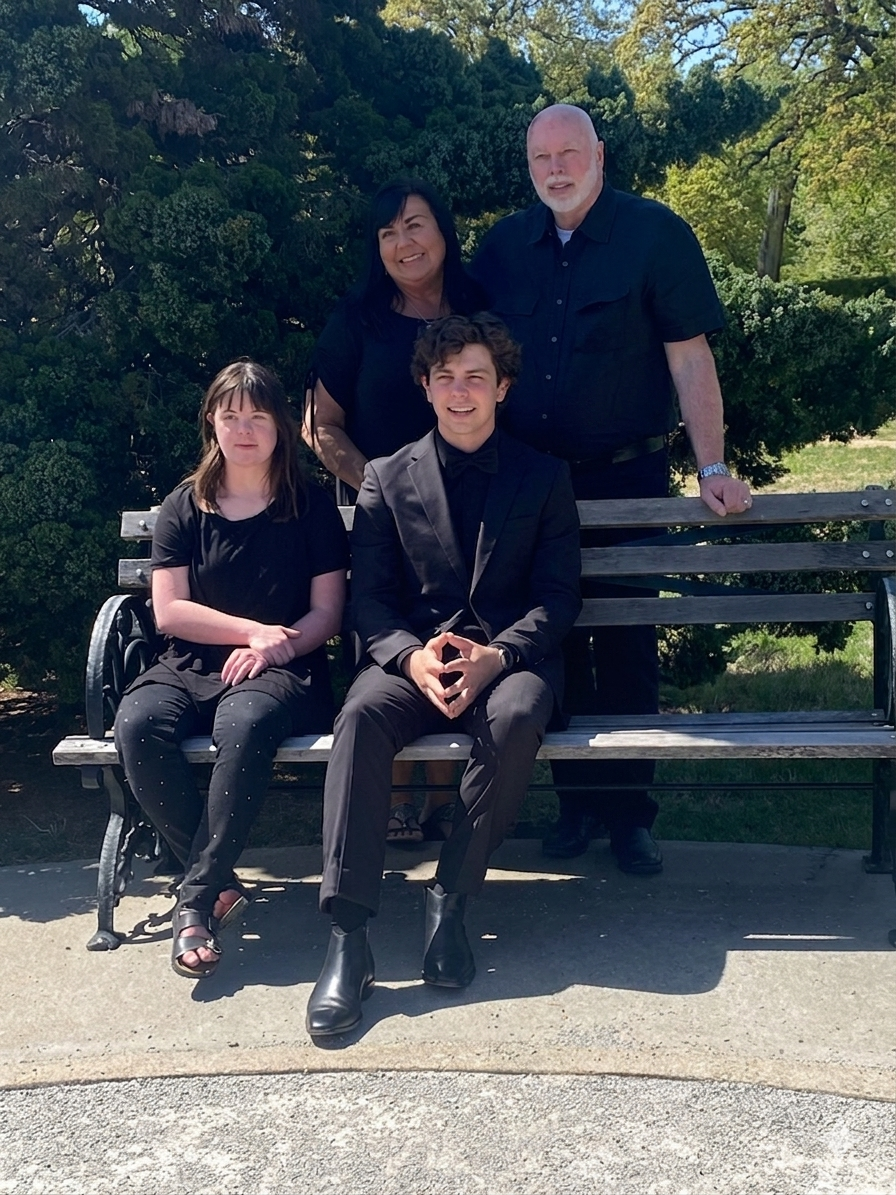
Their names are Richard and Marty, and their son Coleman.
Their daughter, Averie Monet, was born with Down Syndrome, also known as Trisomy 21.
What a Down Syndrome baby does for a family…
She Made Us
I sat across from them over a long thought-provoking lunch and asked them hard questions about welcoming a Down Syndrome baby. I really had no relational capital to ask these kinds of questions. Yet they answered every one of them, with humor, humility, raw honesty, and grace I didn’t deserve, but have, in short order, come to expect. What follows is their story of perseverance. I pass it along to you … without guile.
One of the first things they said, and the line they kept coming back to, was this:
She made us.
Not “we raised her.”
Not “we did the best we could.”
By the time Averie was on the way, Richard and Marty had already lost their first daughter at birth a year earlier. When they were pregnant with Averie, they were offered the screening that most parents are offered.
They declined it.
“We’re Christian, and we’re having her no matter what,” Marty told the doctor.
When Averie was born and the diagnosis came, Richard’s reaction was, “It doesn’t matter – just give me my daughter.”
In an instant, she made her father.
Averie was the teacher. She was not a project.
The Welcome Came First
What Averie made of them was a family in which the child was understood, from the first moments, to be a gift, not a problem.
This blessing didn’t arrive as a reframe or paradigm shift years later.
The blessing was already there in the welcome.
Let’s camp on this for a moment.
The cultural conversation around Down Syndrome, and others like it, lives almost entirely downstream with a different worldview. According to a study from August 2025 in The National Library of Medicine, upwards of eight in ten pregnancies that come back with that diagnosis are ended. You may have been gently – or not so gently – presented with the option. The premise of the screening is that this is a problem to be solved by subtraction.
Richard and Marty’s family started from a different place, and every story I’m about to tell you rests on that foundation.
The clearest sign that you truly embrace someone made in the image of God as a blessing is the peace that comes when you stop questioning. Stop questioning whether to receive them and trust the Giver of all good gifts.
They had settled on an answer before the question arrived. tling it that way did not make the road easy. Averie spent four months in the NICU. They were told more than once to plan her funeral.
She came home without the physician-ordered monitors. Marty’s grandmother – who had worked in the profession for years – informed her that those machines tell you something about the body, but you treat the patient.
Marty endeavored to learn her daughter, not learn the machine. She pumped milk for two years and fed Averie every hour on the hour because Averie couldn’t take formula. She made her mom from the start.
A feeding tube supplied her nutrition until she was five. Compromised heart and lungs, low muscle tone, every typical complication and a few that weren’t – all required attention. The doctors said she might not walk. Might not talk. Might not know her parents.
If you knew Averie even a little, it wouldn’t surprise you to know that she did all of it. She rewrote the prognosis.
Their son Cole discovered that one of Averie’s teachers had her own baby with Down Syndrome. Riding home in the car after meeting the new baby, he asked his mom Marty, a question in his own very serious way.
He wondered why he was the only kid he knew without Down Syndrome.
He sounded disappointed. Like he was missing out on something.
He was four.
He hadn’t been polluted yet.
He could still see what the rest of us must be re-taught.
Exactly What God Had in Mind
Speaking of her flourishing beyond all expectations, Richard related the following story.
Averie often accompanied her dad when he traveled for work. On one business trip, after landing at LaGuardia Airport, they needed to fight their way onto a rental car shuttle. (One on-the-road rule for Averie was that she had to carry her own bag. No special accommodation.) Carrying her luggage, she pushed her way onto that shuttle ahead of him, elbows flying! An old New Yorker behind them observing her, turned to his friend and said, “Now there’s a New Yorker!” Little did he know that they had just flown in from rural Oklahoma!
That captures her almost perfectly.
She would not let her diagnosis tell her who she was.
They would not let her believe she was limited in any way.
She had been told – by parents who lived what they preached – that she was exactly what God had in mind when He made her, and she believed it.
This is the kind of confidence many of us spend our lives trying to find or manufacture. She came by it honestly because her parents intentionally gave her the foundation to grow it from the beginning.
What produced over twenty-five years was a person whose effect on a room is hard to describe to anyone who hasn’t been in one with her or hasn’t received one of her hugs.
I was a recipient of one of her hugs which made an indelible memory.
Love Without Categories
Marty told me Averie did not see categories.
She saw people.
Averie was loved completely from the day she was born.
She gave it back with such ease and liberality.
Averie and her family were dining out one evening. She noticed some Muslim women in burqas being served at another table. Averie walked over, took their hands, prayed for them in Jesus’ name, and walked back. They knew not what to do with that.
The confused look on their faces must have been a sight!
Once at a doctor’s office, she was asked her nationality. Her response, “I used to be black but now I am a Naked American.” She meant “Native American”. The doctor’s robust laughter immediately sidelined his professional composure!
Averie had a love for glittering Rustic Cuff bracelets. Each time she saw a woman wearing one, she would stop, ask the woman if she could look at it, and let her know how much she admired the bracelet. Each woman decided she couldn’t keep it after watching Averie’s delight in the bracelet. Without fail, the woman gifted it to Averie. Not one of those Rustic Cuff bracelets Averie paid for. Every one of the bracelets handed to her by a stranger. Her collection totaled about fifty!
She gave it back with such ease and liberality.
Her younger brother Coleman, Cole for short, used to beg her on the way into Walmart, “Please, just this once, do not hug anyone”, except the occasional young lady that caught his eye.
Cole, in his twenties now, had the opportunity to attend college hours away. His family encouraged him to go.
He turned it down.
He told his parents he would not be four hours away from his sister.
That wasn’t their doing.
That was hers.
She made her brother, too.
Calming the Fears
I’m telling you about these stories for a reason.
Many parents of children diagnosed with Down Syndrome experience a common fear. That fear centers around the presumption the child received into their family will be defined by what they lack.
The opposite witness Richard and Marty give is much closer to the truth.
This child you receive may possess more than you.
Marty said it without flinching, “Averie’s spirit was more complete than any of ours will ever be.”
That is not sentimentality.
That is the testimony of a woman seeing a child with Down Syndrome as the bearer of God’s image.
Practical Wisdom for Parents Welcoming a Down Syndrome Baby
Two practical things they wanted me to pass on, because they kept circling back to them.
If you’re reading this and the weight and uncertainty of what’s before you cause you doubt, then hear Marty and Richard’s encouragement.
When your foundation is on Christ, you do not have to feel ready.
You might not ever feel ready. In one sense you must prepare yourself, sure, but in another, grace will find you there.Your marriage matters, and you must decide about it today.
Richard and Marty married late and they decided that divorce was off the table. When the strife came – because it always does, and because they had a child whose care could overwhelm anybody – they had to decide. The decision was never whether to stay in this marriage and family. It was how to stay well. Marty’s phrase, “We are not enemies; we have the same goals.”
I want to leave you with the line Marty said she has used for years. Many parents have called her, dazed by the news that their child was diagnosed with Down Syndrome. She would say the same thing every time.
“Welcome to the club. You’re in for a blessing.”
Marty Hight

Has God used an unexpected challenge to reveal an unexpected blessing? Share your story in the comments and encourage another parent walking a similar path.







Leave a Reply