
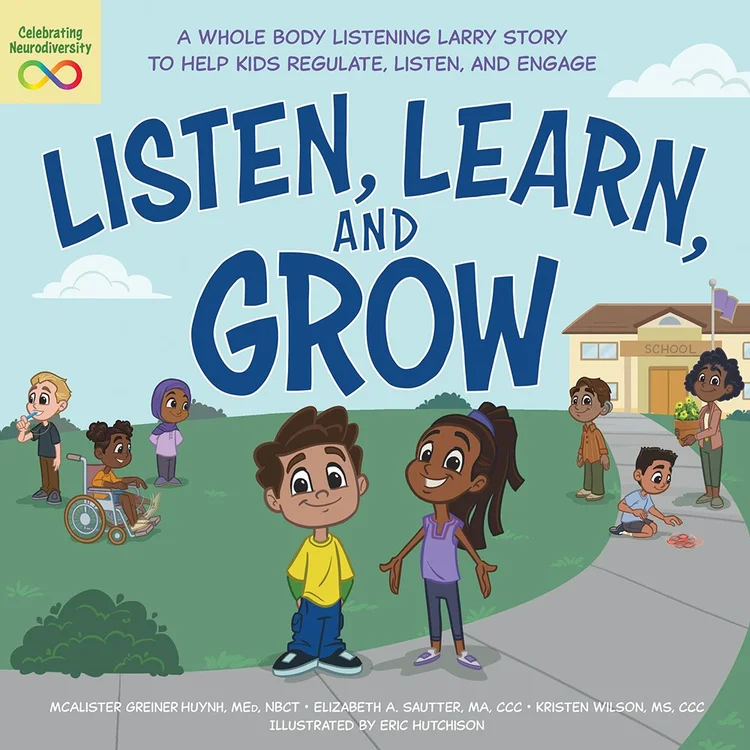
Listen, Learn, Grow: A Whole Body Listening Larry Story to Help Kids Regulate, Listen, and Engage.

Listen, Learn, Grow: A Whole Body Listening Larry Story to Help Kids Regulate, Listen, and Engage.
ISBN-10 : 1683737008
ISBN-13 : 978-1683737001
Published: October 24, 2023
Genres: Literature
Pages: 40
Source: PESI Publishing, Inc.
Cost: $14.99
Rating

If you have a child, special needs or not, I don’t need to tell you that kids need training in active listening!
How many times have we said to our child(ren): “Did you hear me?” or “Your not listening! Listen to me!”
I’ve selected this book to review for several reasons:
- It provides sound teaching that addresses improved active listening.
- Written in a graphic novel format appealing to most kids.
- Easy for parents or other concerned adults to implement at home.
Listening begins at birth. Teaching children how to engage and understand their environment and people. Additionally, effortlessly attach meaning to sounds and words (assuming normal hearing).
Babies can’t help but listen.
But something begins to interfere with our childrens’ attentive listening as he or she grows older.
Attentive listening is essential to success in social relations, reading and literacy, academic skills, and eventually vocational performance.
Some of the distractions to attentive listening include:
- focusing on a preferred task (playing on an electronic device)
- disinterest in required tasks (teaching lesson and associated lesson in class)
- difficulty remembering multiple directions
- lack of understanding figures of speech (“Chill out.”)
- distractions in the environment (i,e., TV playing in background)
Strategies to facilitate Listening Behaviors
Teaching attentive listening became a quest of mine both as a parent dealing with special needs kids and as a Speech-Langauge Pathologist responsible for improving my students’ listening and comprehension at work.
For many years I used a couple of books with good success in improving attentive listening:
- Whole Body Listening Larry at School
- Whole Body Listening Larry at Home
These two books told a story of a boy named Larry teaching all the body parts with which we listen, one by one. The intital therapy session with each student at work started with me reading this book. Almost every subsequent therapy session included a review of essentials for every 20-30 minute session:
- What’s my name?
- Why do you come to speech therapy?
- What are we working on?
- What three body parts (eyes, ears, brain) do we use to listen?
I reduced the number of body parts emphasized to “ears”, “eyes” and “brain” due to time limitations.
Many of my students enjoyed supplying all that information as he/she entered the therapy room and before I even had a chance to ask the 4 questions! To reinforce the use of the body parts I would often look away or close my eyes when he/she spoke. When asked, the student could usually tell me what part was not engaged in listening. The reprimand for me not using all my body parts to listen was a treat for them! We discussed the annoyance he/she felt when ignored.
A couple of years ago, the authors and others from Everyday Regulation adapted the two previously mentioned books. The revised book and teaching strategies reflect “an inclusive model that teaches and encourages listeners to identify what their unique brain and body need in order to regulate, listen, learn, and connect. We are grateful for the information and advocacy of the Neurodivergent community who inspired this change in the Whole Body Listening resources.”
It’s true that when we listen, we often use each ear. But listening is more than receiving what we hear!
Listen, Learn, and Grow is a delightful rhyming story that explores the many ways kids can use their whole body as a listening tool. And here’s a hint: Listening looks different for everyone!
Readers will join Larry and his friend Lori in their classroom as they discover that listening is more than just “hearing” with their ears. It’s about using their eyes, ears, mouth, hands, feet, body, brain, and heart to help them remain regulated, focused, and engaged so they can be successful learners at school.
As a bonus, Listen, Learn, and Grow also includes a variety of activities that educators and parents can use at home, in the classroom, and in the community to encourage whole body listening throughout the day.
My Thoughts
I’ll start at the first page of the book and offer my thoughts as we progress through the book.

The “How To Use This Book and Encourage Discussion” page emphasizes using “natural teachable moments” along with the initial reading of the book with your child. The story line occurs in the school classroom setting. The strategies presented can be taught to apply to the classroom, home, or anywhere the child goes. The author also encourages tailoring the suggestions for whole body listening to your child. I am a huge proponent of self-advocacy (the subject of a future post). I was glad to see the authors encourage the kids to advocate for themselves.

The first page is an introduction written for children. Depending on the age and maturity of your child, it is something a child might enjoy coloring.
The format is like a graphic novel which appeals to most kids.
The teacher pictured in the book introduces the need to the body’s “sensation” and need to “regulate” those sensations. The next page attempts to explain what “regulation” means by comparing it to a seed and the resultant flower. Those two vocabulary items are abstract and will need more explanation and discussion outside reading the book.


Several pages are spent describing what listening is along with and how the different body parts contribute to listening.
The authors describe a “wandering brain”. Two solutions are given to refocus the brain to listen: take a deep breath or count to ten. I’m not sure either one of these is effective in refocusing attention. The child would need prompts to use either one of these strategies until he /she learned they were effective, or whether the child cared nothing about listening on the speaker.


It is true that your child can look at something other than the speaker and still listen attentively. And your child needs to manage his/her difficulties with eye contact common to many special needs children.
It is also true that your child will eventually get out of home or public school. Your child will live in the real world where people don’t really care about his/her sensitivities and expect conformation to typical ways of interaction.
An alternative to no eye contact and typically expected eye contact is using brief eye contact like a capital at the beginning and period at the end of a sentence. At the beginning of a teacher’s/parent’s instruction the child looks at the speaker to signifiy he/she is listening. Then the child can discontinue eye contact as he/she feels comfortable. Another brief gaze toward the speaker at the end of the instruction will signify to the speaker that the child understands the instruction is finished.
The mouth is not taught to be silent since “silence is not the goal”. The child is instructed that “If everyone is learning, please do what works for you.” I agree each child has unique ways to cope with listening difficulties. However, some discussion and instruction is needed when “what works for you” interfers with another child’s ability to listen.
This would be applicable for all body parts.


The last three pages of the book offers ten activities to introduce the concept of whole body listening and nine suggestions for incorporating whole body listening into each day. Again, the focus is on application of these strategies into the classroom. The suggestions can easily be incorporated at home as well.
Take Away
- This book takes the complex skill of attentive listening, breaks it down into its components, and offers strategies for teaching non-neurotypical children active listening.
- Many suggestions are given for introducing the strategies of active listening, how to use the book, and implementation in the classroom throughout the year.
- It is written for use by a teacher in a classroom, but easily adaptable for any parent or care-provider for use in the home.
- This book and concepts are equally useful with neurotypical children.
Disclaimer: I am not affiliated with, endorsed by, or connected to Everyday Regulation or Amazon. My review and all thoughts and opinions expressed here are my own.







Leave a Reply