
Hippotherapy facilitates perseverance
I was released from the hospital in June a month after becoming a quadrapelegic, and spent the next school year receiving my education at home from a teacher for Homebound students. I had no friends left. Even after I went back to school (only for one half of the day initially), interactions with friends were limited to the school hours.
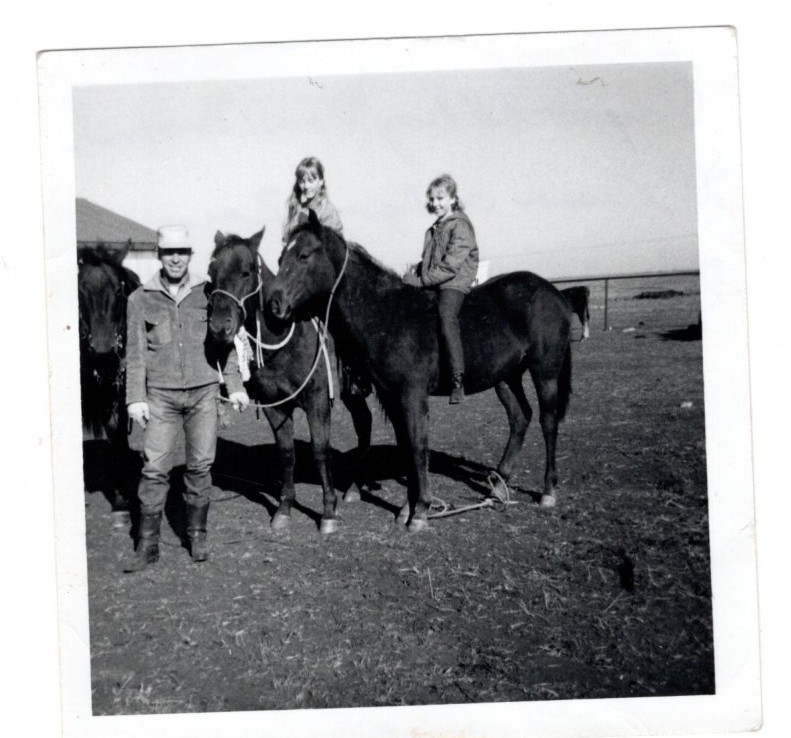
The picture above is a picture of hippotherapy before it was a thing. So what is “hippotherapy”. It has nothing to do with hippos. It has everything to do with persevering and having fun at the same time. Yes, it is possible!
Pictured above (from left to right) is my dad’s horse Roanie, Dad, me on Zero, and my sister Marcia on Maggie. Almost every weekend we would go to the barn behind our house. Dad would saddle up Roanie and Zero. Since I was only twelve and didn’t weigh a lot, he would pick me up and swing me up into the saddle. We took long rides around our property and up and down the dirt roads meandering the country surrounding our house.
It didn’t dawn on me for many years (I was not overly insightful child.) My future life started in the saddle.
Riding with my dad turned out to be much more than just riding with my dad.
Beauty was beginning to form out of ashes (Isaiah 61:3 …to bestow on them a crown of beauty instead of ashes, the oil of joy instead of mourning, and a garment of praise instead of a spirit of despair…).
Even though Zero was doing all the walking, I was going forward.
Many hours in the saddle gave me time for thinking. Just being out in nature: listening to the breeze, hearing the birds chirp, watching the grass sway in the breeze, taking in all the beauty in the sky, and in the vegetation brought a calmness of spirit and somehow a possibility for some life ahead. Like the soothing effect rocking has on a baby, so did the rhythm of Zero’s gait have on me as I rode on his back.
One particular evening I distinctly remember riding around on Zero. Our ride was over. It was getting dark and Zero and I were headed back to the barn. My trunk and hips conformed to the rhythm and movements of his gait.
I distinctly remember thinking to myself “This feels just like walking.”.
My trunk stability, strength and endurance improved, and I began to walk a little bit.
The hours on this calming animal with my attentive dad evaporated my despair.
Twenty years later I learned about hippo therapy. This is a treatment tool physical and occupational therapists use to facilitate sensory and neuromuscular function and improve muscular strength, range of motion, and mobility.
Dad was ahead of his time using a therapy tool that would not be commonly used for another 20 years.
I haven’t been on a horse in years. Yet memories of those many hours in the saddle riding next to my dad remain fresh to this day.
That enjoyable time on horseback gave me time to rebuild my identity, my hope, and my strength.
What dad and I did for enjoyment would later become known as Hippotherapy.
What is Hippotherapy?

The American Hippotherapy Association, Inc. states that it is a tool whereby physical therapists, occupational therapists, and speech-language therapists facilitate improvement in senosory, neuromuscular, and cognitive systems.
“The term hippotherapy refers to how occupational therapy, physical therapy, and speech-language pathology professionals use evidence-based practice and clinical reasoning in the purposeful manipulation of equine movement as a therapy tool to engage sensory, neuromotor, and cognitive systems to promote functional outcomes.
Best practice dictates that occupational therapy, physical therapy, and speech-language pathology professionals integrate hippotherapy into the patient’s plan of care, along with other therapy tools.
Simply put, hippotherapy refers to the use of equine movement (the movement of the horse) as a treatment tool within occupational therapy, physical therapy, or speech-language pathology treatment.
The term hippotherapy originates from the Greek word “hippos” meaning horse (or equine), and roughly translates as “treatment with the help of the horse”.
When including hippotherapy in treatment, therapists carefully select horses for their clients based on their temperament, movement, and conformation. The movement of the horse is then carefully and purposefully manipulated to impact the client. In addition, skilled and licensed healthcare professionals use various developmental positions to further enhance this movement. Hippotherapy is combined with other standard therapy tools in an intervention plan designed to address the treatment needs of the client.
The Association offers the research supporting the eficacy of this treatment approach. “There are more than 100 articles in peer reviewed publications investigating hippotherapy across many patient populations. The research includes hippotherapy used prospectively as a treatment tool, as a viable intervention included in meta-analysis, and as the treatment in single-subject case studies. This work has been published internationally, gaining ground over the last 30 years.”
Four must see videos using Hippotherapy as a treatment tool for children with special needs:
This first is is produced by the American Hippotherapy Association, Inc. It describes hippotherapy and the types of therapists that incorporate this therapy tool into thier treatment plan.
The second video produced by the Shea Center offers a great visual of how the gait of a horse facilitates the myriad of movements neccessary for our gait and how riding acilitates a good gait. I love this one! This is what I could feel on my horse!
The third video produced by Charlottesville Area Riding Therapy shows how hippotherapy is used for different types of people with special needs.
This last video shows hippotherapy used with different kinds of special needs children. Selina the girl in the yellow jacket, has a terrible look on her face. But at the end she sounds like me! She talks about the freedom she has on the horse! She also mentions that “…you accept what is and go with the flow.”
Have you tried hippotherapy with your special needs? If so, what has been your experience and that of your child?








Leave a Reply